
OnlyFans pricing looks simple on the surface, but the 20% platform fee quietly shapes almost every number you see. This article explains how that deduction drives creator pricing decisions, why certain prices cluster where they do, and how BestOnlyFans readers can interpret subscription costs with fee mechanics in mind. The goal is mechanical clarity: what the platform takes, what the creator keeps, and why the visible price tag is never the whole story. BestOnlyFans refreshes its rankings every month.
Most subscribers compare prices as isolated figures. A $9.99 subscription sits next to a $4.99 subscription and the cheaper one appears to offer better value. That comparison misses the structural cost every creator absorbs before a single dollar reaches them.
Understanding the mechanics does not require insider knowledge. It requires knowing one number, 20%, and tracing how that number propagates through base subscriptions, pay-per-view unlocks, private messages, and tips.
The 20% Fee Structure and Creator Revenue Math
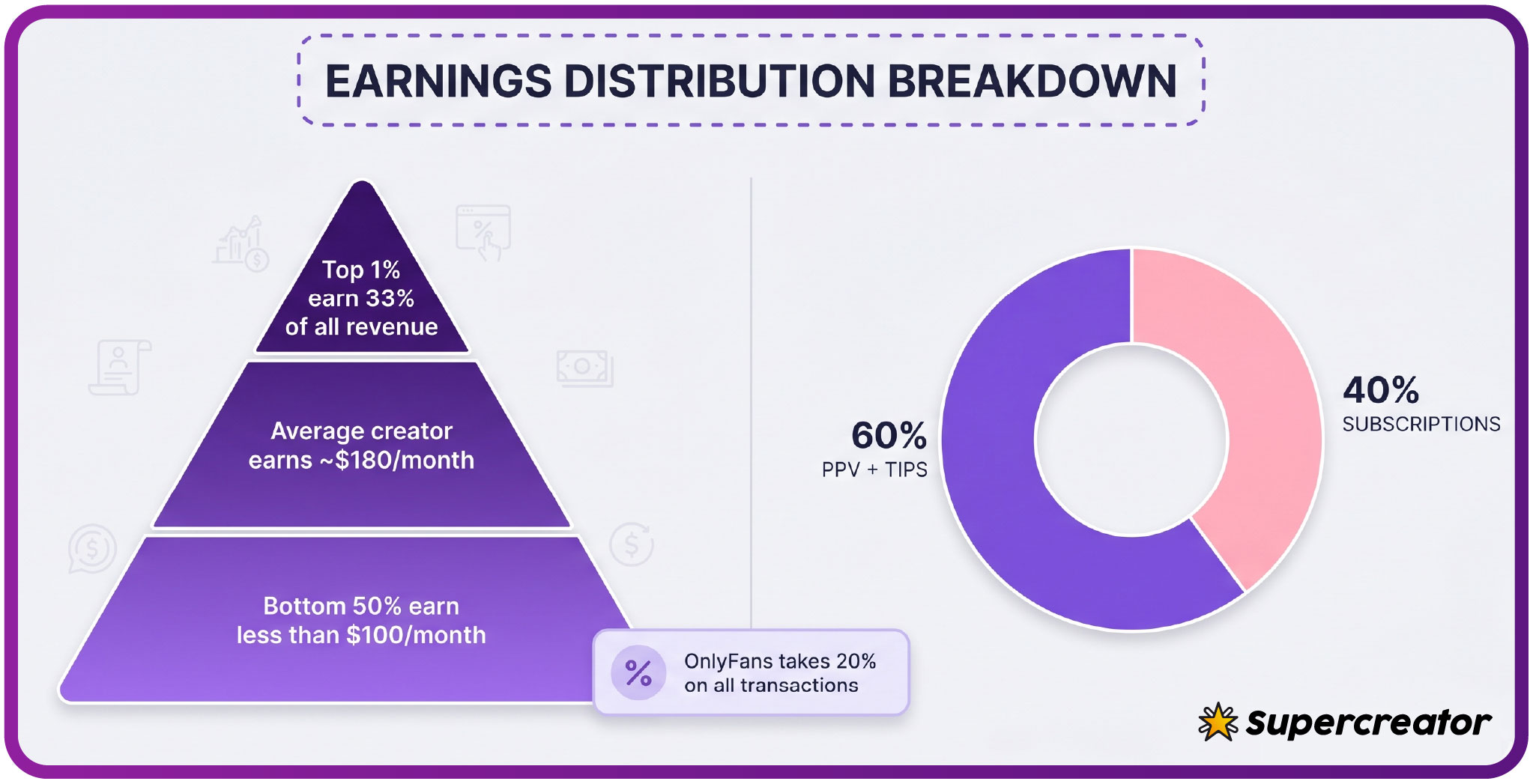
OnlyFans applies a flat 20% platform fee to everything a subscriber spends. For every $10 that leaves a subscriber’s card, the creator receives $8 and the platform keeps $2. The rate does not vary by creator size, content type, or transaction volume.
That uniformity matters. A creator with fifty subscribers and a creator with fifty thousand subscribers face the same percentage deduction. The difference lies in how each absorbs it: smaller creators feel each dollar more acutely, while larger creators can treat the fee as a fixed cost of doing business.
The table below shows the distribution at four representative price points.
| Subscriber Pays | Platform Keeps | Creator Receives |
|---|---|---|
| $4.99 (minimum paid tier) | $1.00 | $3.99 |
| $9.99 (common median) | $2.00 | $7.99 |
| $24.99 (mid-premium) | $5.00 | $19.99 |
| $49.99 (maximum base price) | $10.00 | $39.99 |
At the floor, a creator nets under four dollars per subscriber per month. At the ceiling, the net approaches forty dollars. The content effort required to justify each tier differs enormously, which is why creators gravitate toward specific price points rather than spreading evenly across the range.
The fee also applies to PPV unlocks, paid messages, and tips. A $100 tip delivers $80 to the creator. A $50 PPV unlock delivers $40. Nothing escapes the 20% deduction.
How Fee Recovery Shows Up in Base Subscription Prices
Creators do not simply add 20% to a desired net figure and call it a price. The visible pricing landscape reflects a mix of margin calculations, subscriber psychology, and competitive positioning. Four clusters explain most of what subscribers encounter.
- $4.99 floor compliance: Some creators price at the absolute minimum, accepting thin margins to maximize subscriber count. The net is under four dollars, so this strategy only works at volume.
- $5 to $7.99 volume zone: A slight step up captures subscribers willing to pay a little more while keeping the net high enough to justify regular posting.
- $8 to $12.99 standard marker: This range signals consistent quality and lets the creator absorb the fee without stressing over every subscriber.
- $15 and above premium positioning: At these prices, the fee becomes a smaller share of perceived value, and creators target subscribers seeking exclusivity rather than volume.
The gap between the floor and the common range is not arbitrary. It reflects the minimum net a creator needs to sustain regular output, which sits well above what $4.99 delivers after the platform deduction.
PPV Pricing as Fee-Aware Revenue Optimization
Pay-per-view pricing reveals the fee mechanic even more clearly than subscriptions. The $50 PPV maximum yields $40 to the creator after the platform cut, which frames why that ceiling exists as a meaningful boundary.
- $50 cap analysis: The maximum PPV unlock returns $40 net, enough to justify premium one-off content without pushing subscriber willingness too far.
- $10 to $20 sweet spot: Most PPV unlocks land here, balancing impulse purchase behavior against per-transaction fee recovery.
- $3 to $5 message pricing: Paid chat targets volume over margin, with low per-message prices encouraging repeat interaction.
- $100 tip ceiling: The maximum tip reflects platform risk management rather than creator pricing freedom, and it nets $80 after the fee.
Each price point reflects a trade-off between the 20% deduction and subscriber tolerance. Creators who understand the mechanic price accordingly; those who ignore it often undercharge relative to the effort their content requires.
Tip: when a creator’s PPV prices sit consistently at the top of the $10-$20 range, that usually signals a deliberate fee-recovery strategy rather than random pricing.
Why Promotion Pricing Can Dip Below the Minimum
The $4.99 floor applies to base subscription prices, but promotional first months can legally sit below it. A common example is a $3 first month designed to attract new subscribers who then roll into full-price auto-renewal.
This exception exists because the platform treats promotional pricing as a customer acquisition tool rather than a permanent price. Creators use it to convert curious visitors into paying subscribers, accepting a lower first-month net in exchange for a longer retention window.
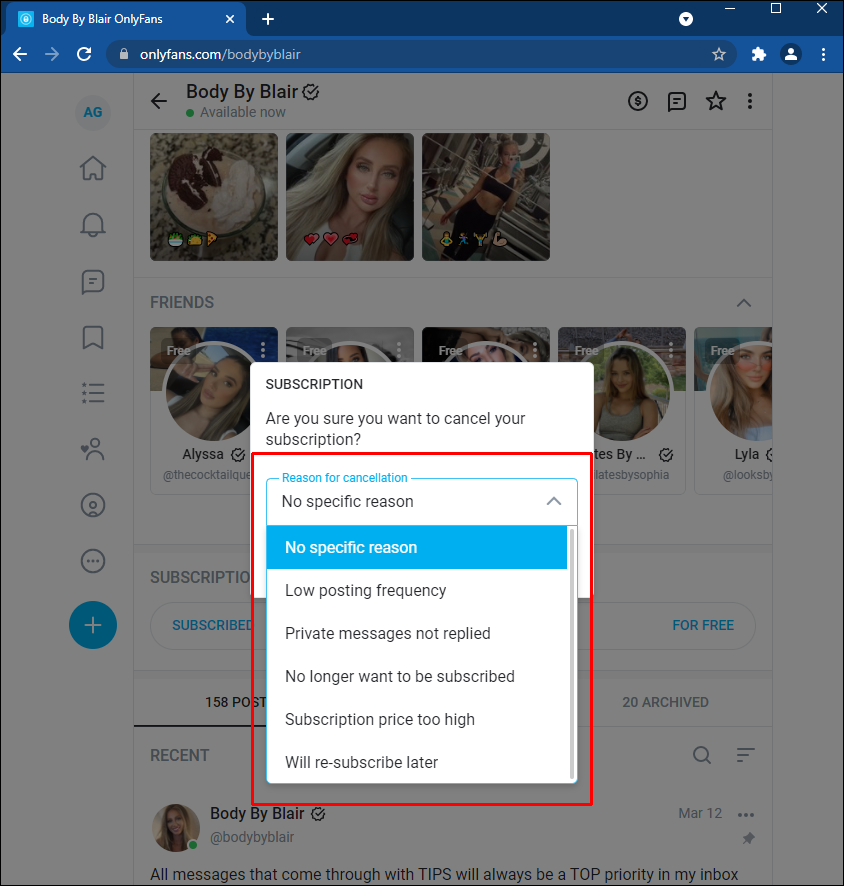
When a creator raises the price after a promotion ends, auto-renew stops for existing subscribers. Those subscribers keep access until their paid period finishes, then must actively re-subscribe at the new rate. This mechanic protects subscribers from surprise charges while giving creators room to adjust pricing as their content evolves.
Reading Ranking Cards With Fee Awareness
Price history data on ranking cards becomes far more useful when you read it through the lens of fee mechanics. A stable price suggests a creator whose revenue meets their needs without testing subscriber tolerance. Frequent small increases often indicate a creator adjusting for platform fee erosion over time. Sudden large jumps usually point to external cost pressure or a deliberate strategy shift rather than a change in content quality.
- Price stability: Suggests the creator meets revenue goals without stress-testing subscribers.
- Frequent small increases: Indicates gradual adjustment for fee erosion and rising production costs.
- Sudden large jumps: Points to external pressure or strategy change unrelated to content quality.
This is where the ranking methodology behind BestOnlyFans adds practical value: tracking how prices move over time, not just where they sit today, gives subscribers a clearer picture of creator intent. A creator who has held the same price for two years is signaling something different from one who raises it every quarter.
Subscriber Budgeting With True Cost Transparency
Fee awareness changes how you should think about your monthly spend. If you budget $100 across subscriptions, PPV, and tips, only $80 reaches creators. The remaining $20 is platform cost, not creator support.
- Recognize that $20 of every $100 spent goes to the platform, not the creator.
- Compare net-to-creator across different spending mixes before deciding where to allocate.
- Weight direct tip value against subscription route efficiency for the creator.
- Assess whether PPV or subscription yields better creator support per dollar spent.
- Evaluate total spend against your budget ceiling without conflating gross and net figures.
This mental gross-up does not mean avoiding the platform. It means making deliberate choices about which spending route delivers the most value to the creator you want to support.
Comparing OnlyFans to Platforms With Different Fee Structures
Not every creator platform applies the same fee model, and the differences shape subscriber-facing pricing in distinct ways. Some platforms absorb the fee into a uniform price, meaning the subscriber never sees the deduction. Others use hybrid models where a membership fee sits alongside per-transaction charges.
| Fee Visibility | Subscriber Pricing Impact | Creator Behavior Incentive |
|---|---|---|
| Platform-visible fee (OnlyFans model) | Subscribers see base prices set with the 20% cut in mind | Creators price to recover net revenue, producing visible clustering |
| Creator-absorbed fee | Subscribers see uniform prices regardless of platform cut | Creators adjust content volume rather than price tags |
| Hybrid membership-plus-fee | Subscribers pay membership and per-transaction costs separately | Creators optimize for membership retention over transaction volume |
The OnlyFans model is unusually transparent. Subscribers can infer the fee from any published price, which makes price comparison more meaningful across creators even when the underlying costs differ.

When Fee Awareness Changes Subscription Decisions
Once you understand the 20% mechanic, a few decision triggers become clearer. The question shifts from “is this price fair” to “does this price reflect quality, fee recovery, or something else.”
- Choose higher-priced creators who demonstrate reinvestment in content rather than pure cost-passing.
- Favor creators who discuss pricing transparently in their messaging.
- Prefer bundle or multi-month options that reduce per-transaction fee friction.
- Evaluate whether alternative support channels exist if the platform fee feels excessive.
Fee awareness does not automatically favor cheaper subscriptions. A $15 creator who posts consistently may deliver more net value than a $5 creator who rarely updates, even though the visible price gap looks large.
For broader creator coverage and ranking context, sources like best onlyfans youtube roundups can help connect pricing patterns to creator output over time.
FAQ
Does the 20% OnlyFans fee ever change based on creator earnings volume?
No. The 20% fee is flat and applies uniformly regardless of how much a creator earns. A creator netting $500 monthly and one netting $50,000 monthly both face the same percentage deduction on every transaction.
Why do some creators charge exactly $4.99 when they could price higher?
The $4.99 floor is the lowest legal base price. Creators who use it typically prioritize subscriber volume over per-subscriber margin, betting that a larger audience compensates for the thinner net after the platform fee.
If I tip on OnlyFans, does the platform still take 20% before the creator sees it?
Yes. Tips are subject to the same 20% deduction as subscriptions and PPV unlocks. A $100 tip delivers $80 to the creator, with the platform retaining $20.
How can I tell from a ranking card whether a creator’s pricing reflects platform fees or content quality?
Look at price movement over time. Stable pricing usually signals a creator meeting revenue needs without fee pressure. Frequent increases suggest adjustment for fee erosion, while sudden jumps often reflect strategy changes rather than content quality shifts.